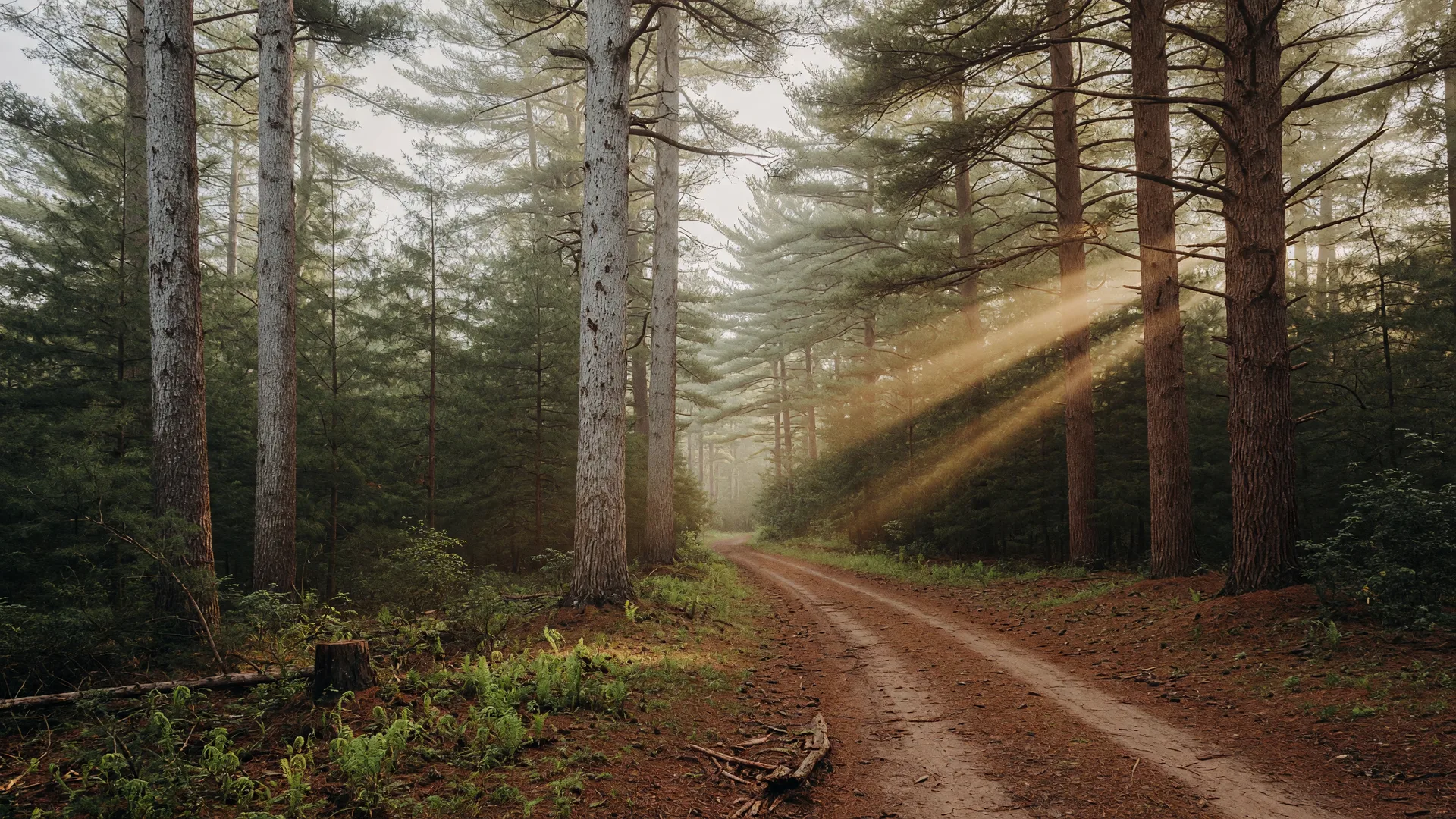
If you live on the Whitefish Chain, you live on water shaped by loggers. The lakes you boat across, the channels you cruise through, the very landscape of this part of Minnesota is not just a gift of glaciers from ten thousand years ago. It is also the work of men with axes, peaveys, and ambition who came through here a century and a half ago and changed everything.
This is the story of how Crosslake went from a wilderness of towering white pine to a logging boomtown, and how the waterways that were built to float timber to market became one of the finest lake destinations in the upper Midwest.
Before the Axes Fell
Long before any sawmill whistle echoed across these waters, the Sioux and the Chippewa (Ojibwe) people knew this country intimately. They traveled the lakes and rivers in birchbark canoes, fished the clear waters for walleye and pike, and followed game trails through the dense pine forests that blanketed the land. The lakes were not barriers to them. They were roads.
In 1836, a French-born scientist and explorer named Joseph Nicollet set out to map the region between the Mississippi and Missouri rivers. Accompanied by a small party that included the young John C. Fremont, Nicollet traveled through this area and across what would later be called the Whitefish Chain. His journals described a landscape of pristine lakes, dense forests, and streams so clear you could see the bottom at twenty feet. He could not have known that within fifty years, the roar of the sawmill would replace the call of the loon.
The United States government had other ideas for this country. Congress appropriated funds to construct six dams on the Mississippi River and its tributaries, with the goal of improving navigation and, more importantly, moving timber. One of those dams would be built on the Pine River. And that dam would create Crosslake.
The Dam That Changed Everything
The Pine River Dam was completed in 1885, and it changed everything. Its purpose was simple but transformative: by raising the water level and controlling the flow between the lakes, the dam connected the Whitefish Chain into a single navigable system. Logs that had been trapped in landlocked lakes could now be floated downstream, through the chain, down the Pine River, and eventually to the sawmills of the Mississippi.
Before the dam, individual lakes in the chain were separated by rapids, narrows, and shallow stretches that made log driving impossible. After the dam, the entire chain was a water highway. The logs moved. And where the logs moved, the money followed.
Enter the Crosslake Lumber Company. It became the cornerstone of the local economy, a sprawling operation that at its peak housed up to 1,400 workers. Think about that number for a moment. Crosslake today has a year-round population of about 2,400. At the height of the logging boom, a single company employed more than half that many men. This was a massive industrial operation sitting in what was then a remote corner of Minnesota.
The logging headquarters were located just east of Cross Lake itself, positioned at the nerve center of the operation. A railway was built to haul logs from the Longville area south to Cross Lake, a testament to the scale of the enterprise. Timber came from miles around, feeding an insatiable demand from the growing cities of the Midwest.
Most of the timber was Norway Pine and White Pine, Minnesota's iconic trees. These were not saplings. The white pines that covered this land were giants: straight-trunked, three feet in diameter, rising a hundred feet into the sky. Some individual logs contained 12,000 board feet of lumber each. To put that in perspective, a typical modern house uses about 15,000 board feet. A single tree could frame a house.
Sometimes thirty million feet of logs would go downriver in a single drive. Picture that: more lumber than in a whole subdivision of modern homes, all moving downstream in a single season, bouncing off the rocks, jamming in the narrows, filling the river from bank to bank.
The Men Who Moved the Timber
The work was brutal. The men who drove those logs were called river pigs or log drivers, and they earned every penny of their pay by walking on floating, spinning, treacherous logs in ice-cold water. A single misstep meant a broken leg between two logs, or being swept under a jam, or losing a hand to a peavey. The mortality rate was high, and the Minnesota winters did not care.
Logging camps housed hundreds of workers through brutal winters. The men slept in bunkhouses heated by wood stoves, ate beans and salt pork and hardtack, and worked from sunup to sundown in temperatures that could drop to forty below. The camps were rough places, and the culture that grew up around them was a frontier culture through and through. Fights, whiskey, and hard luck stories were as much a part of the logging camp as the saw and the axe.
Many of the workers were immigrants. Swedes, Norwegians, and Finns came to the Minnesota woods because they knew cold and they knew hard work. They brought with them the logging traditions of Scandinavia, the rhythms of the axe and the saw that had been passed down through generations. Their names are still on the land around here. Johanson. Olson. Anderson. The legacy of those immigrant families runs through Crosslake like the grain through a pine board.
When the Timber Ran Out
Logging in the Crosslake area came to an end around 1912. It did not stop because the loggers wanted to stop. It stopped because the trees were gone.
The great white pine forests had been largely cut over. Where endless stands of towering timber had stretched to the horizon, there was now stumps, brush, and the silent evidence of a boom that had consumed itself. The Crosslake Lumber Company wound down its operations. The workers moved on to other camps further north, or to the cities, or back to the old country. The railway fell silent. The sawmill stopped running.
But the legacy remained. The Pine River Dam still stood, still controlling the water levels of the chain. The lakes were still connected, still navigable from end to end. The channels that had been cut for log drives were still open. And the small communities that had grown up around the mills did not disappear. They just reinvented themselves.
From Logging Town to Lake Town
As logging faded, a new industry began to emerge. Tourists from the Twin Cities discovered the Whitefish Chain. They came by train and later by car, drawn by the same clear waters and pine-scented air that had drawn the loggers for an entirely different reason.
The connected lakes that had been built for log transportation became the foundation for recreation. Families began building cabins. Resorts sprang up on the sites of old logging camps. The mill ponds became swimming holes. The log drives became boat parades.
The Whitefish Chain went from a working waterway to a vacation destination. It happened gradually at first, then picked up speed as the post-war boom put more families in cars and more cars on the road north. By the 1960s, Crosslake was well on its way to becoming the lake town it is today. Many of the original logging camps and mill sites became the resorts and marinas that still anchor the local economy.
Traces of the Past
You can still see the traces of the logging era if you know where to look. The Pine River Dam still stands, rebuilt and modernized but serving the same essential function it has for over a century. The Crosslake Historical Society preserves buildings from the 1800s and early 1900s, including structures that date back to the logging era. Old photographs show the river choked with logs, the mill yard stacked with lumber, the faces of men who built this town with their hands.
The connected lake system that loggers built is now one of Minnesota's premier boating and recreation destinations. The 14 lakes of the Whitefish Chain, linked by channels and controlled by the Pine River Dam, offer 115 miles of shoreline and over 14,000 acres of water. It is a boater's paradise, a fisherman's dream, and a lake lover's home.
Living on the Whitefish Chain means living on waterways that were literally carved out of the wilderness by the logging industry. When you own a home on this chain, you are part of a story that goes back generations. The lakes you look out over every morning were shaped by glaciers, yes, but they were connected and opened by the sweat and determination of men who saw opportunity in the tall timber.
A property like 12388 Brookwood Circle sits on that same chain, on the same water that once floated millions of board feet of white pine to market. The beach you walk on, the water you swim in, the view from the deck, it all carries the echo of that history. When you buy a lake home here, you do not just buy a piece of real estate. You buy a piece of that story.
The logging era ended more than a century ago, but the Whitefish Chain is its living monument. Every time a pontoon boat cruises through a channel between two lakes, every time a family swims off a sandy beach, every time someone casts a line into water that once held a river of logs, the legacy of the loggers lives on. They came here to take the timber. They left behind a chain of lakes that has given generations of families a place to belong.
Interested in finding your own piece of Whitefish Chain history? Noah Goedker is a third-generation Lakes Area agent who knows the Crosslake market. Let's find your place in this story.
Contact Noah