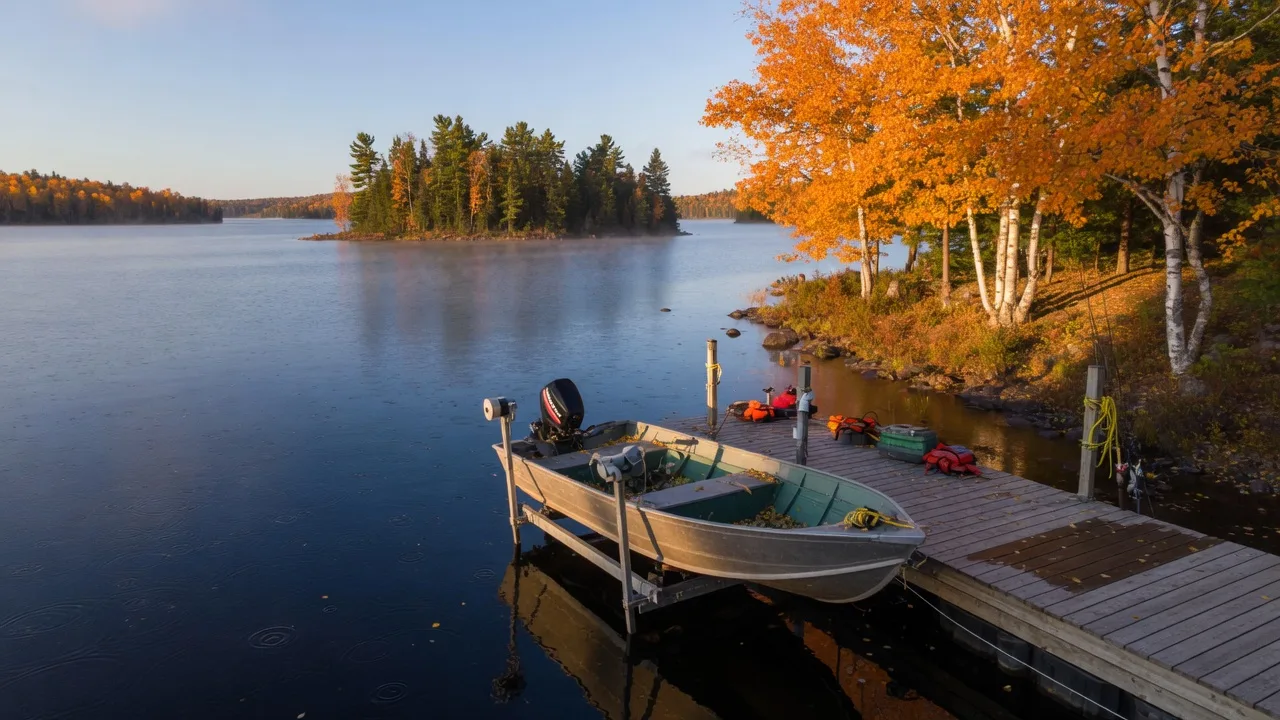
On the Whitefish Chain the boating season ends once, and you are the one in control of it. The ice does not care whether the boat is off the lift or the dock is secure, so the fall pull-out matters more for the gear than the summer launch does for the fun. This is a lake home owner's practical checklist for winterizing boats, docks, and lifts near Crosslake before the lake locks up, including Minnesota's aquatic invasive species rules that apply to every one of them.
Why the timing matters on the Whitefish Chain
The Whitefish Chain starts to cool fast after Labor Day, and by mid-to-late fall the overnight lows flirt with freezing. Once the ice begins to form, the job gets harder and more dangerous. Ice expands, heaves, and grinds against anything left in the water, and that includes your boat sitting on a lift. A boat that stays in too long is wrecked, and a permanent dock handled badly can be twisted off its posts. The local rhythm is simple: the docks and lifts come out during fall color, before the first hard freeze, and the boats are winterized while the weather still allows the service work.
Winterization should start before overnight temperatures are consistently near freezing, not after. If you run the furnace-style double check: the boat, the dock, and the lift each need their own walk-through, and none of them should be done in the dark on Thanksgiving weekend.
Clean, drain, dispose: the state law that protects every lake
Minnesota law is direct about invasive species: it is illegal to launch or leave a watercraft with water, aquatic plants, or prohibited species aboard. The state's shorthand is Clean, Drain, Dispose, and it is not optional on the Whitefish Chain, where zebra mussels and other invasives are a standing threat to the lakes you love.
When you pull the boat this fall, clean every visible aquatic plant, zebra mussel, and other prohibited species off the watercraft, trailer, and all water-related equipment. Drain all water from the boat, motor, ballast tanks, livewell, bilge, and portable bait containers, remove the drain plugs, and keep the plugs out while you transport it. Dispose of unwanted bait in the trash, never the lake. Civil penalties run up to $500 per violation, but the honest reason to do it is the chain itself, one careless launch can undo decades of prevention work.
The state's DNR site has the complete checklist in one place; it is worth a bookmark for anyone who lives on Minnesota chain water.
Seven things a boat wants before the freeze
Winterizing a boat is mostly about getting every drop of water out of somewhere it can freeze. A few hours now saves a split block or a cracked lower unit in March. Here is the sequence a marine tech would run, and the same order works fine in your driveway:
- Flush the engine with freshwater and run it to operating temperature, then change the oil and filter.
- Add fuel stabilizer to a full tank and run the engine to push it through the system.
- Fog the cylinders so the inside of the engine spends winter coated, not bare.
- Drain the engine block, manifolds, and all water systems, including raw-water washdowns, livewells, ballast, freshwater tanks, and bilge pump lines.
- Run non-toxic, pink antifreeze made for marine systems through the lines to displace any water the drain missed.
- Drain and service the lower unit and gearcase, and check the propeller for weeds and damage from the season.
- Disconnect and charge the battery, or pull it and keep it inside, and give the whole boat a wash and a wax before the cover goes on.
The weather is on your side in September and October. Local marine shops and mobile mechanics book up fast once the first freeze warning enters the forecast, so if this is your first winter on the chain, plan the service call now instead of racing the forecast in October.
The dock and the lift need their own annual retirement
A boat lift and a dock handle ice completely differently than a boat does, and the rules for them have an invasive species twist most people have not heard: Minnesota law requires that docks, lifts, and swim rafts be removed from the water and left out to dry for at least 21 days before being moved to another waterbody. That rule is real, it protects against visitors, and it is exactly the kind of requirement that only hurts you if you do not know it, so tell your dock crew or the neighbors who help you haul.
Before the freeze, pull the boat off the lift and store it out of the water on its trailer or in the boathouse if you have one. Then clean the doc: wash off the winter at the waterline, remove ladders, bumpers, benches, and cleats that can come loose and drift, and rinse the whole structure so it dries clean. If your lift or dock stays in over soft-bottom bays, check with a local service company that knows the chain's ice behavior; some lanes on the Whitefish keep the structure in with bubblers or ice posts, and that is a professional job, not a weekend one.
If you own a seasonal dock, a permanent dock, or a swim raft, the decision is either pull it completely or secure it for the ice heave. The Minnesota DNR prefers temporary docks and lift structures over permanent ones, because permanent structures take the full force of the ice heave and become a hazard on the snow-covered lake for snowmobilers and ice anglers. Whatever you decide, disconnect shore power and any water lines to the structure before the freeze, drain the freshwater lines, and shut off the breakers so nobody finds a live wire under next spring's thaw.
The fall checklist belongs on your buying list too
If you are shopping for a lake home this fall, this checklist is also a great set of seller questions. Ask what comes with the shore: does the dock and lift stay, are they in good condition, and are they pulled and stored every winter. Ask whether the seasonal structures are removed or left in all year, and whether there is any service history on the lift. On a property like 12388 Brookwood Circle, where the beach, the dock, and the sandbar are the heart of the place, how the shoreline structures have been cared for tells you a lot about the lake house itself.
Fall is the season you can still watch all of it happen. Standing on a clean beach in September with the boat on the lift shows you exactly what you are getting ready for winter, and getting it right is one of the cheaper ways to protect the whole investment.
The payoff of a good fall day
The boats and docks that live on the Whitefish Chain longest are the ones whose owners did the unglamorous fall work: flushed, fogged, drained, covered, hauled, and snug in the rack. It is not exciting work, but it is the exact kind of stewardship that keeps the water, the shoreline, and the value of the chain intact. If you are new to lake living, or if you took over a home that never got the full treatment, fall is the perfect second chance this year.
12388 Brookwood Circle is a lakefront cabin on the Whitefish Chain with a private sandy beach, an elevated deck, and a wood-burning fireplace. Fall is the perfect season to see the beach, test the winter sight from the sunroom, and ask questions like these about how the shoreline is cared for. Contact Noah for a showing.
Contact Noah